Tuesday, February 16, 2010

Carolee Schneemann

http://images.artnet.com/WebServices/picture.aspx?date=20040520&catalog=18393&gallery=111588&lot=00514&filetype=2


http://www.caroleeschneemann.com
Carolee Schneemann, multidisciplinary artist. Transformed the definition of art, especially discourse on the body, sexuality, and gender. The history of her work is characterized by research into archaic visual traditions, pleasure wrested from suppressive taboos, the body of the artist in dynamic relationship with the social body.

Painting, photography, performance art and installation works shown at Los Angeles Museum of Contemporary Art; Whitney Museum of American Art; Museum of Modern Art, NYC; Centre Georges Pompidou, Paris; and most recently in a retrospective at the New Museum of Contemporary Art in New York entitled “Up To And Including Her Limits”. Film and video retrospectives Centre Georges Pompidou, Paris; Museum of Modern Art, NY; National Film Theatre, London; Whitney Museum, NY; San Francisco Cinematheque; Anthology Film Archives, NYC.

She has taught at many institutions including New York University, California Institute of the Arts, Bard College, the School of the Art Institute of Chicago. Recipient of a 1999 Art Pace International Artist Residency, San Antonio, Texas; Pollock-Krasner Foundation Grant (1997, 1998); 1993 Guggenheim Fellowship; Gottlieb Foundation Grant; National Endowment for the Arts Fellowship. Honorary Doctor of Fine Arts, Maine College of Art, Portland, ME. Lifetime Achievement Award, College Art Association, 2000.

Schneemann has published widely; books include Cezanne, She Was A Great Painter (1976), Early and Recent Work (1983); More Than Meat Joy: Performance Works and Selected Writings (1979, 1997). Forthcoming publications include Imaging Her Erotics, from MIT Press. A selection of her letters edited by Kristine Stiles is also forthcoming.

Claes Oldenberg & Coosje van Bruggen

                                     http://www.eamesoffice.com/jscripts/tiny_mce/plugins/imagemanager/images/oldec01d.jpg
Claes Oldenburg was born in Stockholm, Sweden, the son of a Swedish diplomat. As a child he and his family moved to United States in 1936, first to New York then, later, to Chicago where he graduated from the Latin School of Chicago. He studied at Yale University from 1946 to 1950, then returned to Chicago where he studied under the direction of Paul Wieghardt at the Art Institute of Chicago until 1954.
While further developing his craft, he worked as a reporter at the City News Bureau of Chicago. He also opened his own studio and, in 1953, became a naturalized citizen of the United States. His first recorded sales of artworks were at the 57th Street Art Fair in Chicago, where he sold 5 items for a total price of $25.[1] He moved back to New York City in 1956. There he met a number of artists, including Jim Dine, Red Grooms, and Allan Kaprow, whose Happenings incorporated theatrical aspects and provided an alternative to the abstract expressionism that had come to dominate much of the art scene.
The most memorable aspects of Oldenburg's works are perhaps, the colossal sculptures that he has made. Sculptures, though quite large, often have interactive capabilities. One such interactive early sculpture was a soft sculpture of a tube of lipstick which would deflate unless a participant re-pumped air into it. In 1974, this sculpture, Lipstick (Ascending) on Caterpillar Tracks, was redesigned in a sturdier aluminum form, the giant lipstick being placed vertically atop tank treads. Originally installed in Beinecke Plaza at Yale, it now resides in the Morse College courtyard.
Many of Oldenburg's giant sculptures of mundane objects elicited public ridicule before being embraced as whimsical, insightful, and fun additions to public outdoor art. In the 1960s he became associated with the Pop Art movement and attended many so-called happenings, which were performance art related productions of that time. The name he gave to his own productions was "Ray Gun Theatre". His first wife -(1960–1970) Pat Muschinski who sewed many of his early soft sculptures, was a constant performer in his happenings. This brash, often humorous approach to art, was at great odds with the prevailing sensibility that, by its nature, art dealt with "profound" expressions or ideas. But Oldenburg's spirited art found first a niche then a great popularity that endures to this day.
He has collaborated with Dutch/American pop sculptor Coosje van Bruggen since 1976. They were married in 1977.
In 1988, he and van Bruggen collaborated to create the iconic Spoonbridge and Cherry sculpture for the Walker Art Center in Minneapolis, MN that remains a staple of the Minneapolis Sculpture Garden as well as a classic image of the city.
In addition to freestanding projects, he occasionally contributes to architectural projects, most notably the former Chiat/Day advertising agency headquarters in the Venice district of Los Angeles, California—the main entrance is a pair of giant black binoculars. The advertising agency DDB is the current tenant.
Another well known construction is the Free Stamp in downtown Cleveland, Ohio. This Free Stamp has a small, yet energetic cult following.
In 2001, Oldenburg and van Bruggen created 'Dropped Cone', a large upturned ice cream cone, which can be found on top of a shopping centre in Cologne, Germany
Van Bruggen studied history of art at the University of Groningen. From 1967 to 1971 she worked at the Stedelijk Museum in Amsterdam. Until 1976 van Bruggen taught at the Academy for Art and Industries in Enschede. Since 1976 she worked in 1977. In 1978 Van Bruggen moved to New York, in 1993 she became a United States citizen.
Together with Oldenburg she designed several large scaled sculptures such as the Inverted Collar and Tie in Frankfurt am Main. Since the early 1980s Van Bruggen worked as an independent critic and curator. In 1982 she was member of the selection committee of the documenta 7 in Kassel. In 1988, her work along with Oldenburg Spoonbridge and Cherry was commissioned by the Walker Art Center, and became a permanent fixture of the Minneapolis Sculpture Garden as well as an iconic image of the city of Minneapolis. Van Bruggen published books about the early work of Oldenburg, the Guggenheim Museum Bilbao and the works of Bruce Nauman.

Monday, February 15, 2010

Lynda Benglis

Lynda Benglis (born October 25, 1941 in Lake Charles, Louisiana) is an American sculptor known for her wax paintings and poured latex sculptures. Benglis' work is noted for an unusual blend of organic imagery and confrontation with newer media incorporating influences such as Barnett Newman and Andy Warhol. Her early work used materials such as beeswax before moving on large polyurethane pieces in the 1970s and later to gold-leaf, zinc, and aluminum. The validity of much of her work was questioned until the 1980s due to its use of sensuality and physicality.
Like other artists such as Yves Klein, Benglis' mimicked Jackson Pollock's flinging and dripping methods of painting. Works such as Fallen Painting (1968) inform the approach with a feminist perspective. For this work, Benglis smeared Day-Glo paint across the gallery floor invoking "the depravity of the 'fallen' woman" or, from a feminist perspective, a "prone victim of phallic male desire". These brightly colored organic floor pieces were intended to disrupt the male-dominated minimalism movement with their suggestiveness and openness. In 1971, Benglis began to collaborate with Robert Morris, creating Benglis' video Mumble (1972) and Morris' Exchange (1973).

James Coleman

James Coleman, born in Ballaghaderreen, County Roscommon in 1941, is an Irish installation and video artist associated with slide-tape works: sequences of still images fading one into the other with synchronized sound. Often, social situations are depicted with a precision which, paradoxically, creates a narrative ambiguity.
James Coleman studied at the National College of Art and Design, Dublin and at University College, Dublin and then spent time in Paris and London before moving to Milan, where he stayed for twenty years. He now lives and works in Ireland. He represented Ireland in the 1973 Paris Biennale.
Recognised internationally as one of the most important and pioneering contemporary artists, the work of James Coleman over the last forty years has transformed the role of image and sound in visual art, and redefined our relationship with the artworks we see today in museums and galleries around the world. His influence can be seen in a generation of younger international artists, including Steve McQueen, Douglas Gordon, Tino Sehgal, Stan Douglas, and Jeff Wall.


In Ireland, James Coleman remains a figure little known to a wider audience. Yet, internationally, his work is recognised as having had a pioneering influence on contemporary art over the last forty years.

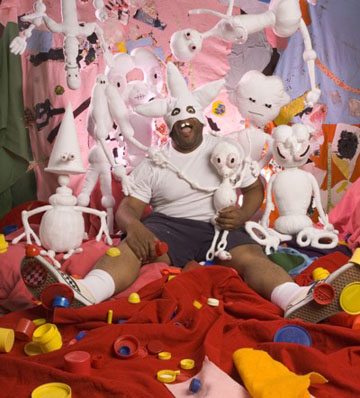
Trenton Doyle Hancock

Trenton Doyle Hancock is an American fine artist who was born in 1974 in Oklahoma City, Oklahoma.
Hancock received a BFA from Texas A&M University, Commerce, Texas and an MFA from the Tyler School of Art at Temple University, Philadelphia. Hancock makes prints, drawings, and collaged felt paintings which tell stories of a fantastical nature.
The characters which populate his imaginary worlds include the Mounds, half-animal, half-plant creatures, which are preyed upon by evil beings called vegans. The usual meaning of the word vegan is a human who avoids leather, meat, milk and other products considered by the vegan lifestyle to be unethical, but in Trenton Doyle Hancock's work these people with their ethical lifestyle are merely being used by these "vegan" creatures.

Clare Langan

http://www.clarelangan.com/

Annie On Ni Wan

A young activist in interactive art and an innovator in interactive technologies, Annie has achieved Bachelor of Arts in Creative Media from School of reativeMedia, City University of Hong Kong in 2001. She then worked for School of Design, HK Polytechnic University as Research Assistant and one of the largest performance and theater group in Hong Kong, Zuni Icosahedron as Project Co- ordinator and video designer.

GeoLeds installation, LED, immersive, conceptual, GPS

GeoLeds is an realtime location-based LED sculpture project developed from GPS technology in TCM Iceland Workshop and electronics experiment from my previos project TeleCart.

It reconstructs and reveals my experience during the workshop in Iceland towards her special nature, i.e weather, duration of daylight in summer, natural resources, etc. The artwork made with numerous LEDs flashing patterns. Those patterns in dot-matrix style showing maps by various different cartographic methods such as temperature, active rift regions, glacier region, political boundary, etc. The alteration of both latitude and longitude streaming from a server drives the switching from pattern to pattern.

Since the nature of flashing LEDs create a sense of vagueness, it challenges people's recognition of patterns, hence it constructs a in-the-edge of chaos experience and sense of timeless-ness.

It also enhances the medium specifity of locative media using GPS technology as an art interface. Unlike other locative-based artwork transforms or visualise data on a 2D screeen, GeoLeds is a sculpture exists in physical space. It emphasis the exploration of geographical location and physical space as an interface.

Technics
The project mainly consist of 4 physical parts, the bluetooth-enabled GPS receiver, the database server streaming the data, a Mac PowerBook G4 and the LEDs sculpture with microcomputer.

A bluetooth-enabled GPS receiver receives the latitude, longitude of the user's current position. It sends the data to the server via GPRS-enabled mobile phone which is connected to the Internet.

The databsed streaming server both receiving and sending those GPS data at the same time. A Mac PowerBook G4 receiving those streaming data via TCP network protocol. The PowerBook runs a customised program written in Pure Data. My program receives the streaming data.

Meanwhile it sends the processed streaming data to the microcomputer. The microcomputer runs my program written in PBASIC programming language decodes the processed streaming data and lights the LEDs with my designed patterns